Multidimensional poverty refers to a measure of poverty that looks beyond income or monetary factors alone. It takes into account various dimensions of well-being, such as health, education, access to basic services, and standard of living. This approach recognizes that poverty is not solely determined by economic factors, but is also influenced by social and environmental aspects. By measuring multiple dimensions of poverty, policymakers can gain a more comprehensive understanding of the challenges faced by individuals and communities and develop more effective strategies to address poverty.
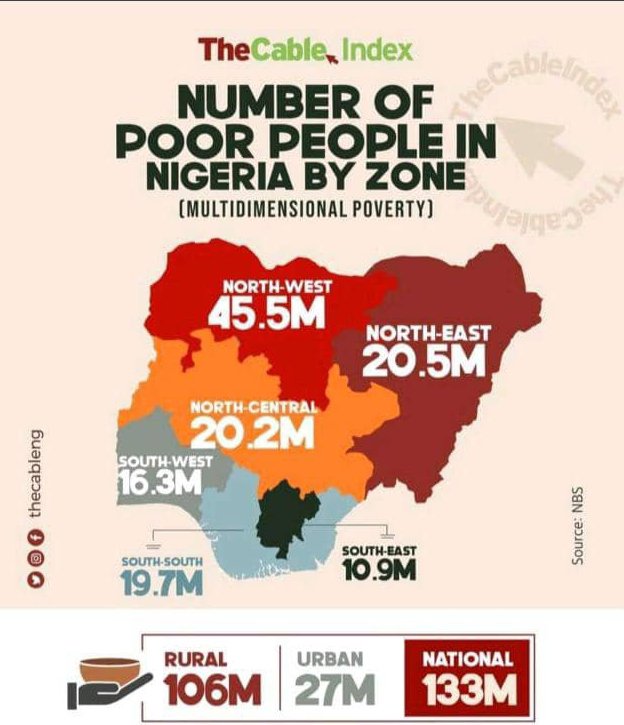
The NORTH-EAST has the highest number of 45.5 millions poverty that looks beyond income and monetary factors and also account of well-being such as health ,education and basic services and standard of living (good roads, electricity, water).
NORTH- EAST has 20.5millions number of people who are poverty and it is the second in multidimensional poverty the communities approach recognizes that poverty is not solely determined by economic factors, but is also influenced by social and environmental aspects and also lack of health, education, good electricity.
NORTH -CENTRAL has 20.2 millions of people who are poverty and it is also the intermediary By measuring multiple dimensions of poverty, policymakers can gain a more comprehensive understanding of the challenges faced by individuals and communities and develop more effective strategies to address poverty.
These are just some of the numerous factors that contribute to poverty. It is a complex issue requiring comprehensive solutions and efforts from both individuals and society to address.
SOUTH-WEST has 16.3 millions of people who are poverty challenges faced by individuals and communities and develop more effective strategies to address poverty.
SOUTH-SOUTh has 19.7 million of people who are Poverty as state or condition in which the community are lacks of financial resources or basic necessities to meet their basic needs, such as food, shelter, education, and healthcare. It is often measured by income level or standard of living.
SOUTH -EAST has 10.19 millions of people who are poverty and also lack of education , unemployment, inadequate social support, health issues and insufficient infrastructure.
RURAl Part of the countrt has 106 millions of people who are poverty
URBAN part has 27 millions of Multidimensional poverty
While the NATiONAL has 13.3 millions of poverty which leads to the following factors in 2020
- Lack of education: Limited access to quality education can hinder individuals from acquiring the necessary skills and knowledge to secure stable employment and higher income.
- Unemployment and underemployment: A lack of job opportunities or low-paying jobs can make it challenging for individuals or families to escape poverty.
- Inadequate social support: Insufficient access to welfare programs, social security, or safety nets can leave individuals and families vulnerable to poverty.
- Discrimination and inequality: Societal discrimination based on factors such as gender, race, ethnicity, or disability can limit opportunities and contribute to poverty.
- Health issues: Poor health can lead to increased medical expenses and decreased productivity, making it difficult for individuals and families to escape poverty.
- Geographic location: Poverty rates can vary across regions, with rural areas often experiencing higher levels of poverty due to limited economic opportunities.
- Insufficient infrastructure: Lack of access to basic infrastructure, such as clean water, sanitation, transportation, and energy, can hinder economic development and perpetuate poverty.
- Intergenerational poverty: Poverty can be passed down from one generation to the next due to limited access to education, resources, and opportunities.

 Rammy's fashion blog